Clannad and Clannad: After Story are pretty popular shows, so I thought I should check it out. But it only took a few episodes to make me hate this series. Biggest weakness – the characters (a shame, because the story had potential) if you have somebody like Nagisa Furukawa, who is one of my least likable main character of all time, then it's just painful to watch this show.
I figured everything out quickly, because every character is a damn stereotype, even if you try to compensate with a tragic background, they're still boring cliché characters, that I couldn't identify with (especially the girls). Except funny dad Akio Furukawa, every one pissed me off, excuse my French. But let's keep it real, what is the most important thing in ANY anime (especially romance)? That's right, the characters!
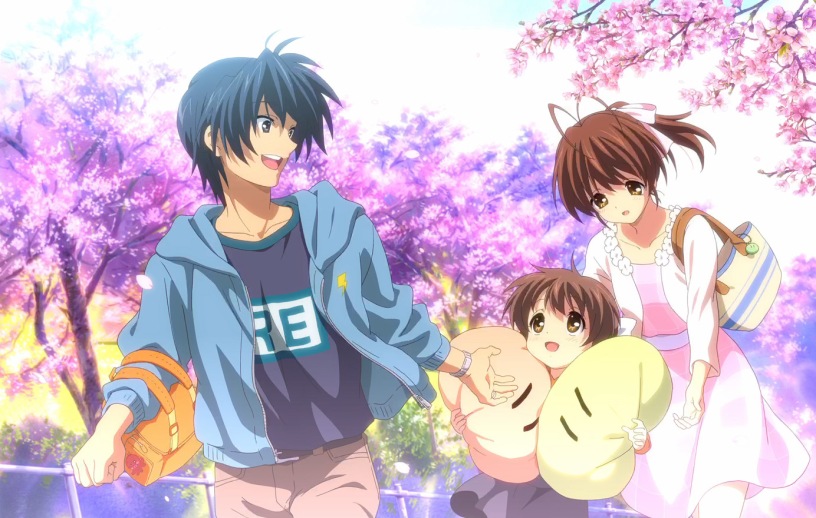
Tomoya and Nagisa face the challenges of adulthood, marriage, and parenthood. The series explores their journey through the joys and hardships of life, including the profound impact of family, friendship, and personal growth. The anime tries to delve into emotional and dramatic themes, especially family bonds.
But is it really enough for so many to see some kawaii girls and a troubled boy trying to figure out life? There are so many great anime out there, with similar and definitely better plots, writing, animation.... I can't believe I was able to sit through all episodes. The pseudo melancholic moments, that didn't move me at all, all the forced drama, the first half didn't have much to do with the second half of the anime, but apparently made other people very emo. These characters don't exist in real life, I continue to say that because this show is not just trying to be magical, it wants to be realistic, which is the main problem, it isn't! Very disappointed how mediocre this show is, after reading so many good reviews about it. I will say though, the animation was the saving grace.
Clannad and Clannad: After Story Review – A Critical Look Behind the Melodrama
Few anime in the romance and drama genres enjoy a reputation as legendary as Clannad and its sequel, Clannad: After Story. Produced by the renowned Kyoto Animation and based on the visual novel by Key, this franchise is widely celebrated as one of the ultimate tearjerkers in animation history. However, when stripped of its nostalgic status and examined through a critical lens, the series reveals significant narrative flaws, pacing issues, and structural decisions that prevent it from being a truly cohesive masterpiece.
The Premise: From High School Harem to Adult Reality
The story follows Tomoya Okazaki, a cynical high school delinquent who feels suffocated by the monotony of his daily life and a strained relationship with his father. His world begins to change when he meets Nagisa Furukawa, a sweet but sickly girl who wants to revive the school's defunct drama club. The first season functions primarily as a standard harem visual novel adaptation, where Tomoya spends his time solving the personal, often supernatural problems of various female classmates.
The narrative shifts dramatically in After Story, which is the section of the franchise that receives the highest praise. It transitions away from high school tropes and follows Tomoya and Nagisa into adulthood, exploring real-world struggles such as entry-level employment, financial stability, marriage, illness, and the heavy burdens of parenthood.
The Problem with Pacing and Emotional Manipulation
The primary issue with the franchise lies in its uneven distribution of quality and narrative focus. The entire first season consists of repetitive, formulaic character arcs that feel like unnecessary filler for viewers who are primarily interested in the main relationship. Many of these side stories rely heavily on supernatural melodrama that feels detached from the grounded, human elements introduced later on.
Furthermore, the drama frequently crosses the line into emotional manipulation. Instead of allowing tragedy to develop naturally through character choices, the narrative repeatedly inflicts extreme, calculated misery upon its characters solely to force a crying response from the audience. This structural choice can feel exhausting and unearned, especially when combined with Nagisa's overly passive, fragile personality, which leaves her with very little agency as a protagonist.
The Controversial Ending and Technical Merits
The critical flaw that compromises the weight of the entire story is the controversial resolution of After Story. After forcing the viewer through hours of devastating grief and realistic hardship, the narrative abruptly utilizes a supernatural plot device involving magical light orbs to reverse previous tragic events. This literal deus ex machina provides a standard happy ending, but it simultaneously erases the emotional consequences and lessons of the adult arc, making the prior suffering feel cheapened.
On a technical level, Kyoto Animation’s production is undeniable. The visual execution features beautifully detailed background art, fluid character movement, and the studio’s signature vibrant color palettes. The soundtrack is equally iconic, utilizing haunting piano melodies like Dango Daik家族 to effectively trigger nostalgia and emotional responses, even if the writing behind those scenes is flawed.
Conclusion: A Polarizing Classic
Final Score: 4/10
Clannad and Clannad: After Story remain historic milestones in the anime industry, but they are far from flawless. While the franchise deserves credit for boldly exploring the realities of adulthood and post-high school life, its impact is heavily weighed down by a tedious first season, a weak main heroine, and a polarizing ending that undoes its own dramatic stakes. It is a fascinating watch for historical context, but viewers looking for tightly written, manipulation-free drama may find themselves disappointed.



No comments:
Post a Comment